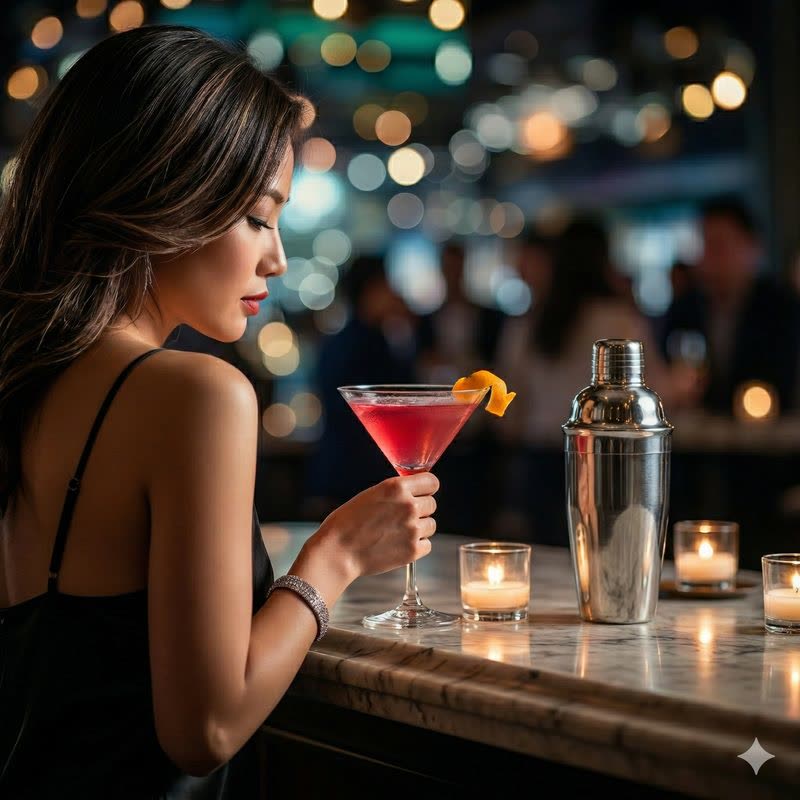
Carrie Bradshaw made the Cosmopolitan famous, but she didn’t make it up. By the time Sarah Jessica Parker raised that martini glass on the first season of Sex and the City in 1998, the drink had already moved through a Navy of bartenders, gay bars in two cities, a Miami nightclub chasing a vodka endorsement deal, and a Lower Manhattan bistro where the modern recipe was pinned down.
The Cosmopolitan is a drink with a real history, and like most drinks that become cultural shorthand, it loses something when the history gets paved over.
Before the show
The earliest versions of the Cosmopolitan circulated in two different rooms. In gay bars in Provincetown, Massachusetts in the late 1970s, and at a Minneapolis steakhouse in 1975, where bartender Neal Murray combined a Kamikaze with cranberry juice. The Kamikaze itself is vodka, triple sec, and lime juice, a drink generally traced to U.S. servicemen in Japan after World War II. Adding cranberry turned a short, sharp drink into something pink and a little friendlier to drink in a room.
In 1985 or 1986, according to her own accounts, Cheryl Cook was bartending at The Strand in South Beach, Miami. A major vodka brand had just released a citrus-flavored vodka and was pushing bars to feature it. Cook needed something that could show off the new product and look striking in a Martini glass. She landed on a version with the citrus vodka, triple sec, a splash of Rose’s Lime, and a little cranberry for color.
Cook’s drink traveled north through bartenders who moved cities. By the late 1980s, a different version of the Cosmopolitan was showing up in New York bars, and Toby Cecchini, working at The Odeon in TriBeCa, is most often credited with the version most drinkers know today. Cecchini has written about the moment in his own book, Cosmopolitan: A Bartender’s Life (2003), and in pieces for Punch Magazine and The New York Times. He replaced Rose’s with fresh lime juice and switched from generic triple sec to a proper orange liqueur. The drink got sharper, less cloying, and more adult.
The Sex and the City moment
When Sex and the City premiered on HBO in June 1998, the Cosmopolitan was already a drink in motion. Carrie, Miranda, Charlotte, and Samantha drinking Cosmopolitans on-screen didn’t invent the drink. What the show did was concentrate it into a single image: four women at a downtown bar, the pink drink in a Martini glass, a life being lived out loud in New York.
The show became a machine that produced Cosmopolitan drinkers. Bars added Cosmopolitans to menus that hadn’t carried them. Orders spiked. The shift is well documented in late-90s and early-2000s reporting from The New York Times Dining section and New York Magazine, which tracked the drink as it moved from Manhattan bars to national chain menus. William Grimes, who was the Times’s restaurant critic at the time and wrote Straight Up or On the Rocks: A Cultural History of American Drink (North Point Press, 2002), placed the Cosmopolitan at the center of the broader cocktail revival that began in the mid-90s and ran through the early 2000s.
And then, as happens with almost any drink that gets this kind of attention, the backlash came. By the mid-2000s, the Cosmopolitan had become a punchline. Basic, before the word meant what it means now.
The irony is that the drink never got worse. The culture around it curdled, but the liquid in the glass stayed the same. A Cosmopolitan is still a Cosmopolitan. Four of them at a downtown bar are still four of them at a downtown bar. The arithmetic has not changed.
I have yet to meet the wife who was disappointed to receive a Cosmo.
What the drink actually is
A Cosmopolitan is a member of the sour family, the oldest and largest category of mixed drinks. A sour is a spirit, a citrus, and a sweetener, balanced for a clean finish. In the Cosmopolitan, the sweetener is orange liqueur. The citrus is lime. The spirit is vodka. Cranberry provides the tint and a supporting flavor, but it isn’t doing the structural work.
This lineage matters because it tells you what makes one good. The Daiquiri is the same shape: rum, lime, sugar. The Margarita is tequila, lime, orange liqueur. The Sidecar is brandy, lemon, orange liqueur. All of them live or die by the ratio of spirit to citrus to sweetness, and the Cosmopolitan follows the same rules.
Making one well
Three things separate a good Cosmopolitan from a bad one.
The vodka has to have body. Thin or harsh vodka collapses under the cranberry and lime, and the drink loses its spine. A clean, creamy vodka with some weight balances the acidity without leaving the drink feeling watery. Silverton Vodka is made from potatoes, which gives it a rounder mouthfeel than most grain-based vodkas, and its finish carries cranberry’s tartness without competing with it.
The orange liqueur has to be an actual bitter-orange liqueur, not a sugary triple sec. Most generic triple secs are neutral sugar syrup with a whisper of orange extract. A real orange liqueur brings peel oil, a touch of bitterness, and warmth that makes the drink finish long instead of flat. Üla Orange Liqueur is built for this role, blended to carry bitter-orange depth rather than just sweetness.
The lime has to be fresh. This is the rule that most home bartenders break, because bottled lime juice is easier. It is also the rule that ruins the most drinks. Bottled lime juice is flat and slightly sulfurous. Fresh lime is bright and complex and holds its own against cranberry instead of disappearing behind it.
Variations worth knowing
The White Cosmopolitan substitutes white cranberry juice for the red. Same acidity, clearer color, more of the lime coming through.
The Cosmopolitan Royale tops the drink with a splash of Champagne or another dry sparkling wine. It works better than it sounds.
A Berry Cosmopolitan uses a berry-infused vodka in place of plain. The drink turns deeper and rounder and is worth trying once.
A Rose’s-style Cosmopolitan uses Rose’s lime cordial in place of fresh lime and simple syrup. You get the older, slightly sweeter version of the drink. Raymond Chandler made his fictional detective Philip Marlowe drink Gimlets this way in The Long Goodbye (1953), and the Cosmopolitan’s Rose’s version sits in the same tradition.
Worth drinking again
If you wrote off the Cosmopolitan during the backlash years, the drink you dismissed may not be the drink that exists. Make one with fresh lime, a proper orange liqueur, and a vodka that has some weight to it, and you have something clean, balanced, and completely unashamed of itself.
The recipe
1½ oz Silverton Vodka 2 oz cranberry juice 1 oz Üla Orange Liqueur ½ oz fresh lime juice
Shake with ice until cold. Strain into a chilled Martini glass. Garnish with a lime twist.
Sources
- Toby Cecchini, Cosmopolitan: A Bartender’s Life (Broadway Books, 2003).
- Toby Cecchini’s essays on the drink’s origin in Punch Magazine and The New York Times.
- William Grimes, Straight Up or On the Rocks: A Cultural History of American Drink (North Point Press, 2002), for the 90s cocktail revival and the Cosmopolitan’s cultural arc.
- New York Times Dining section and New York Magazine archives, late 1990s through early 2000s, for contemporaneous reporting on the revival.
- David Wondrich, Imbibe! (Perigee, 2007), for cocktail family taxonomy.
- Cheryl Cook’s accounts of the Miami origin, as cited in cocktail histories and trade press.
- Sex and the City premiered on HBO, June 6, 1998.
- Difford’s Guide entry on the Cosmopolitan.
About the author
Adam Messick is the founder of Abiqua Spirit Distillery in Silverton, Oregon, with ten years in the craft spirits industry. With help from family and friends, he handles the day-to-day work of blending, bottling, and labeling every release of Silverton Vodka, Gallon House Gin, and Üla Orange Liqueur. Silverton Vodka received the American Distilling Institute’s Gold Medal in 2019. Silverton Vodka, Gallon House Gin, and Üla Orange Liqueur have each won Silver at the San Francisco World Spirits Competition.
Abiqua Spirit Distillery is a small-batch spirits company producing finely crafted potato vodka, gin, and orange liqueur from Silverton, Oregon. Contact: info@abiquaspiritdistillery.com or (503) 837-9869.